15 September 2026
How to help reluctant readers in school: give children more choice
Helping a reluctant reader is rarely about ability — it is about ownership. When a child gets to choose what they read, reading stops being a chore and becomes a choice. Here are three low-cost approaches that work in the classroom: let children bring books from home, let them choose their own, and help them invent a story of their own.
11 September 2026
Why getting your child to write will make them a better reader
Most parents are told to read with their child as much as possible — sound advice. But there is a companion skill that quietly turbocharges reading at the same time, and it gets far less attention: genuine, creative writing. If your child reads reluctantly or finds comprehension tricky, encouraging them to write their own stories may help more than another trip to the library.
11 September 2026
How telling stories out loud helps children read
Reading and storytelling are the same muscle worked from two directions. A child who tells stories out loud — making them up at bedtime, retelling their day, spinning a tale about the dog — is building the very skills that make reading click. Here is why it works, and how a story a child invents themselves turns straight into reading they actually want to do.
6 September 2026
Storywizard is becoming a social enterprise
Storywizard started at a kitchen table, with one reluctant reader and one dad who wanted her to love books again. That reluctant reader was my daughter Harper. Watching her light up when she became the hero of her own story is the reason this business exists — and it is the reason we are now changing what kind of business it is.
Storywizard is converting to a social enterprise model.
For us this is not a marketing badge. It is a commitment, written into how the company is structured, that Storywizard exists to do a job in the world first and foremost: to help children read, create and believe they can. Getting more children reading — especially the ones who have decided reading "isn't for them" — is the point of the whole thing.
A social enterprise still trades, still sells, still has to stand on its own feet commercially. The difference is where the purpose sits. Profit stops being the reason the company exists and becomes the fuel for the mission instead. It means we can commit properly to the work we already care most about: getting personalised books into the hands of children who need them, supporting schools, and reaching families and pupils who would otherwise be priced out.
It also changes the conversations we can have. Schools, charities, funders and social-impact partners can work with an organisation whose mission is locked in by its structure, not left to goodwill. That opens doors for the children we most want to reach.
Nothing changes about the product you already know. Every book is still personalised, still built around your child, still made to the same standard. The stories, the quality and the care stay exactly as they are.
What changes is why we are doing it — now stated plainly, and built to last.
This is a beginning, not an announcement of something finished. We will share more as the structure is formalised. For now, thank you to every parent, teacher and child who has been part of Storywizard so far. You are the reason it is worth building properly.
— Martin, Founder, Storywizard
24 August 2026
Now you can listen: audiobooks come to Storywizard personalised children's books
Every personalised children's book created on Storywizard.uk can now be turned into an audiobook — the child's own story, written by them, read aloud from start to finish.
For £9.99 you can add narration to any book you create. The story is recorded chapter by chapter in a warm British voice, and each chapter opens by announcing its number and title, just as a published audiobook does. The tracks play straight through as one continuous listen, so nobody has to fiddle between chapters at bedtime or in the car. The recording is yours to keep — download it and play it any time, offline, with no app and no subscription.
Some children want this because reading is hard work. Children with dyslexia or a visual impairment, and children with additional needs, get exactly the same pride from hearing their own story that other children get from reading it, and teachers tell us a child who struggles on the page will happily listen to a chapter they wrote themselves.
Just as many children simply prefer to listen. Audiobooks are how a huge number of young readers now choose to enjoy stories — in the car, on holiday, at bedtime, or with the lights off. Preferring your ears to your eyes is not a shortcoming; it is a taste, and it deserves the same quality of story.
It works beautifully alongside the printed book too. Children can follow the words on the page while they listen, which is one of the simplest and best-evidenced ways to build reading confidence.
Create a personalised children's book at storywizard.uk and choose the audiobook at checkout.
16 August 2026
Storywizard joins BESA Launchpad
Storywizard has joined BESA Launchpad. Storywizard makes a personalised children's book from a child's own story idea, and being on Launchpad puts us inside the organisation that represents the UK education supply sector.
BESA — the British Educational Suppliers Association — has served UK education for around ninety years and represents close to 400 suppliers, from publishers and furniture makers to educational technology companies. It founded the Bett show in 1985. It is not-for-profit, and accountable to a council elected by its own members.
Launchpad is BESA's programme for UK start-ups and smaller companies coming into the education market. It exists because getting established as a supplier to schools is difficult, and difficult for good reasons: schools are careful about who they buy from, and rightly so. Launchpad gives newer companies access to BESA's market research, policy updates, training and events while they build the track record that full membership requires.
For a school, the part that matters is the Code of Practice. Every company connected to BESA signs it — a commitment to responsible business practice and to the quality of what is sold. It is one of the few marks in this sector that a school can actually check.
What this changes for us is straightforward. We get proper data on what schools need rather than guesswork, we sit alongside established suppliers, and a headteacher weighing up whether to trust a small company has somewhere independent to look.
Storywizard turns a child's own story idea into a real printed book with their name on the cover as the author. Schools can read more on our schools page, or email help@storywizard.uk.
3 August 2026
Bedtime reading: what to do when your child won't sit still for a story
Bedtime reading is meant to be the calm ten minutes at the end of the day. In plenty of houses it is the opposite — the wriggling, the page-flipping, the small voice asking how many pages are left. If that is your evening, the problem is almost never the child's attention span.
Watch what happens when the story is about something they chose. A child who cannot sit through four pages of someone else's book will sit bolt upright through fifteen of their own, because they already know roughly what is coming and they want to see whether we got it right.
Three things that make bedtime reading easier.
Read the same book again. Repetition looks like a rut to an adult and feels like mastery to a child. A book they can nearly recite is a book they will read to you rather than sit through.
Stop before they want you to. Ending mid-chapter while they are still interested does more for tomorrow night than finishing tonight ever will.
Let them be the one reading. Even a page. Even badly. The point of bedtime is not to get through a book, it is to get them holding one.
That last one is where a Storywizard book earns its keep. Your child invents the story, we print it as a real paperback or hardback with their name on the cover, and it is written for the reading age you choose — so it is short enough to finish and easy enough to read aloud without help. It becomes the book they ask for, which is a very different thing from the book you suggest.
Start your child's story at storywizard.uk — designed and printed in Britain.
2 August 2026
Got a reluctant reader? Start with a story they invented themselves
Getting children reading is the problem almost every parent recognises — the nightly negotiation, the book that never leaves the bedside table. The numbers say it is not just your house. The National Literacy Trust's June 2026 survey of 125,375 children found that only 36.1% of 8 to 18 year olds enjoy reading in their free time, and just 20.3% read daily.
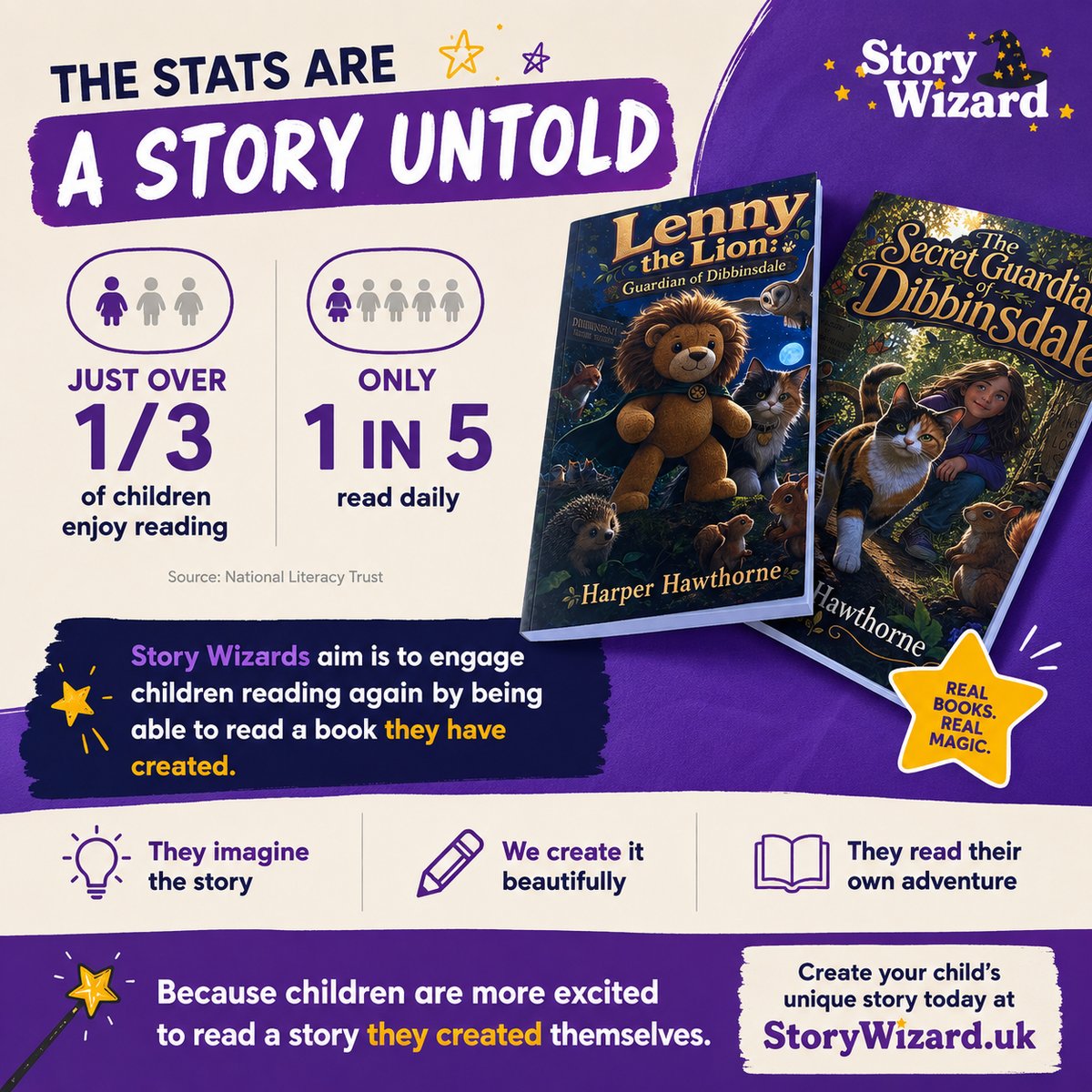
A reluctant reader is rarely a child who cannot read. It is usually a child who has not yet met a book that feels like theirs. Reading a story written by a stranger, about a stranger, is a hard sell when a screen is within reach.
That is the whole idea behind Storywizard. Your child invents the story, the characters and the key events. We write it from their plan and print it as a real paperback or hardback with their name on the cover as the author. Nothing encourages a child to read more than a book they created.
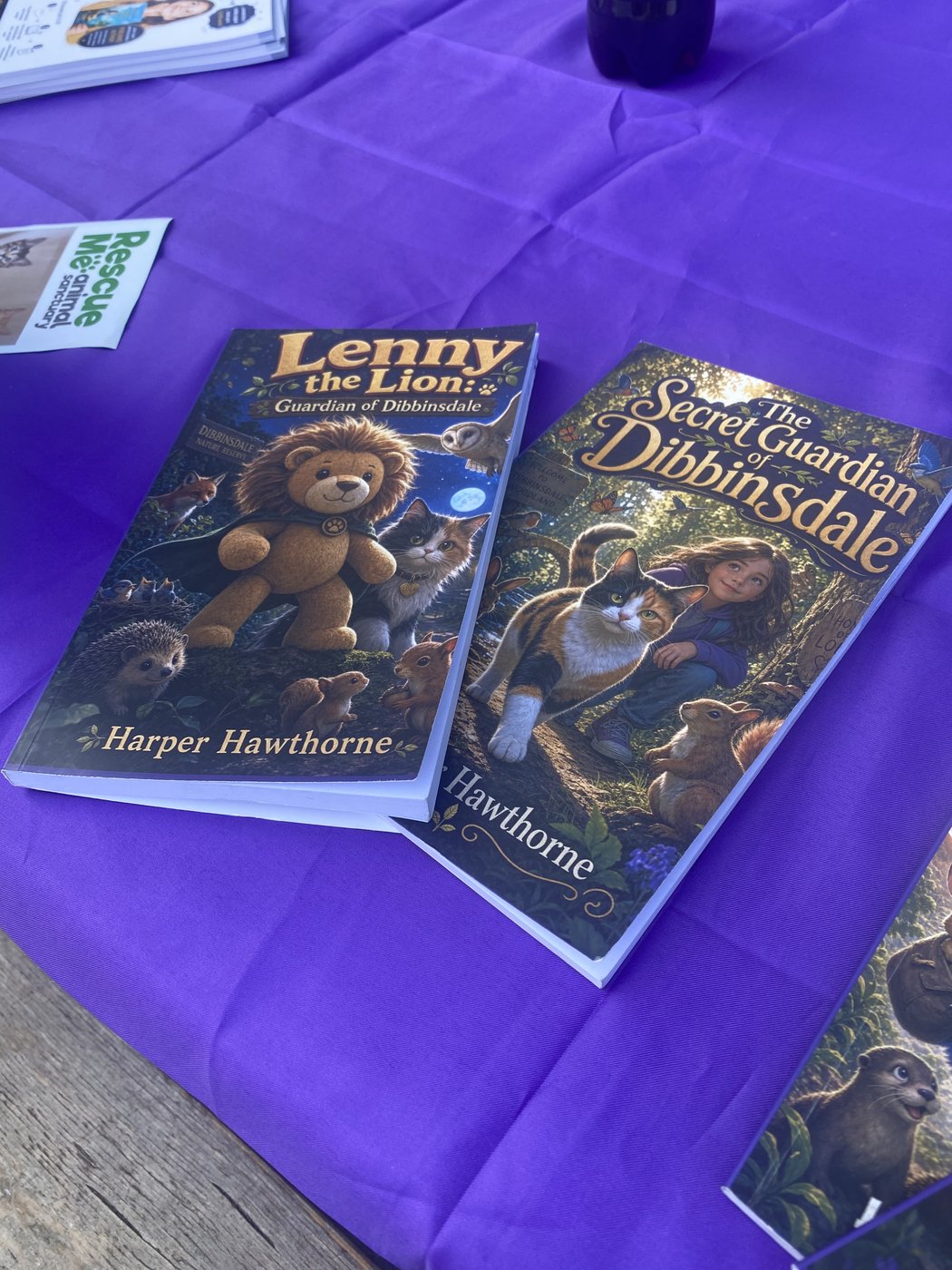
The two books here are exactly that: Lenny the Lion: Guardian of Dibbinsdale and The Secret Guardian of Dibbinsdale, both by Harper Hawthorne, on the table at our book festival stall.
Three things that help a reluctant reader at home.
Let them choose the subject, however odd. Ownership beats quality every time.
Give the reading an audience. A younger sibling, a grandparent, a friend who wants to know what happens.
Keep it short and finishable. Confidence comes from finishing, not from persevering.
The last one is why every Storywizard book is built around the reading age you choose, so your child finishes it and asks for another.
Create your child's story at storywizard.uk — designed and printed in Britain, ten minutes from idea to a real book.
2 August 2026
We're launching at the Liverpool Book Festival
Storywizard launches officially at the Liverpool Book Festival on 2 August, at Box Park in Liverpool. It is the region's largest book festival — more than sixty local authors, talks, live music, artisan stalls, street food and a children's zone — which makes it the right place to show people what a child-written book actually looks like.
We will have finished books on the table. Not mock-ups: real paperbacks, written from a child's own plot, illustrated throughout, with the child's own name on the cover. You can pick them up and read them, and see how a personalised children's book differs from one with a name dropped into it.
There is 50% off at the festival, on the day only. It is not available online, before or after.
We also want to make an argument while we are there. Most talk about children and AI is about what it takes away. Storywizard is the opposite case: the child decides the characters, the plot, the problem and the ending, and the technology does the part that used to make it impossible — writing it out at length and illustrating it. The child is the author. That is AI worth having.
And we will explain how we work with schools. Storywizard offers class bundles priced by size, so every child in a class writes and illustrates their own book. Pupils describe their characters in words, so there are no photographs to collect and no consent forms. It links straight to composition and creative writing, and children end up reading each other's books.
Come and find us. Bring a child with an idea.
29 July 2026
Personalised children's books can now include your family's faces
Storywizard now makes personalised children's books that carry a real likeness. Add a photo of anyone in the story — a child, a grandparent, a best friend, even the family cat — and they are drawn as a character inside the illustrations.
The distinction matters. Most personalised children's books work by dropping a name into a story that was written for everybody. This is the opposite. The plot is the child's own, the characters are theirs, and now the people in those illustrations look like the people they actually know.
It is a likeness, not a photograph. Nothing is pasted onto the page. The illustrator draws the character into whatever the story says is happening — running through woods, climbing a cliff, diving for a catch — and that character simply happens to have your daughter's face, or your dad's, or the cat's.
Adding a photo is entirely optional, and a book without one works exactly as it did before. Up to four characters in a book can have a photo, which keeps production quick. A clear photo of one face works best: close up, well lit, with nobody else in the picture.
On privacy, the rules are short. Photos are used only to draw the illustrations. They are not kept between visits, so a customer returning later adds them again. Every photo is deleted once the illustrations have been drawn. Schools do not use photographs at all — pupils describe their characters in words, so there is nothing to collect and no consent forms to chase.
Everything else is unchanged. Each book is still written from the child's own plot, still illustrated throughout, and still printed as a real paperback with the child's name on the cover, posted free anywhere in the UK.
27 July 2026
Storywizard on BBC Radio Merseyside
Storywizard began with a nine-year-old. Harper had the idea that a child should be able to write their own book — a real one, printed and bound, with their own name on the cover — and that idea became Storywizard.
On 27 July she joined Kevin Duala on BBC Radio Merseyside at 7.25am to talk about where the idea came from, and how any child can now write and illustrate a personalised children's book of their own.
It is a simple thing to explain, which is rather the point. A child chooses how long they want their book to be, invents their characters, and says what happens in the story. Storywizard writes and illustrates the whole book from that plot, shows them a cover and a synopsis within seconds, and prints the finished paperback to be posted anywhere in the UK.
What Harper understood is something a lot of reading schemes miss: children read what they care about. A personalised children's book is not a book with a name dropped into it. It is the child's own plot, their own characters, and now the faces of their own family drawn into the illustrations.
Harper is still part of it, and will keep adding her ideas as Storywizard grows. The aim she started with is the one we still have — to make children want to read, by letting them write the thing they read.
Featured
La Vida Liverpool tells Harper's story
La Vida Liverpool told the story behind Storywizard: how a nine-year-old's idea grew into a company helping children become real, published authors.
The idea itself is simple. Harper wanted to write her own book — not a school exercise book, a proper one, printed and bound, with her name on the cover. The obstacle was never imagination. Children have plenty of that. It was everything after the idea: writing twenty thousand words, illustrating it, and getting it printed.
Storywizard removes that obstacle without taking the authorship away. A child chooses how long their book should be, invents their characters, describes how they look and what they do, and says what happens in the story. From that, Storywizard writes and illustrates the whole book, shows them a cover and a synopsis within seconds, and prints a real paperback that is posted free anywhere in the UK.
Local press picked it up because it is a local story — a Wirral family, a nine-year-old's idea, and a product built around children in this region before anywhere else. Being written about at home matters more than being written about anywhere.
Since the feature, personalised children's books from Storywizard have gone a step further: a child can now add a photograph of anyone in their story, and that person is drawn into the illustrations as a character. Their family, their friends, their pets.
We also work with schools, with class bundles priced by size so every child in a class writes and illustrates a book of their own — no photographs needed, and no consent forms to chase.